
ears, the same question resurfaces with growing urgency: “Is it too late to buy Bitcoin?” In 2013, it was after Bitcoin passed $100. In 2017, when it surged past $10,000. Again in 2021, as it neared $60,000. And now, in 2025, with Bitcoin recently reaching new all-time highs above $107,000, the question is louder than ever.
If you’re reading this, chances are you’re watching Bitcoin soar and wondering whether you’ve missed the boat—or if there’s still time to climb aboard. Let’s break it down with data, market psychology, and future potential to answer the question: Is it too late to buy Bitcoin in 2025?
Bitcoin’s Historical Pattern: Late Is a Myth
Let’s start with a truth that often gets lost in the hype: It’s never really “too late” to invest in a long-term growth asset—if you understand what you’re buying.
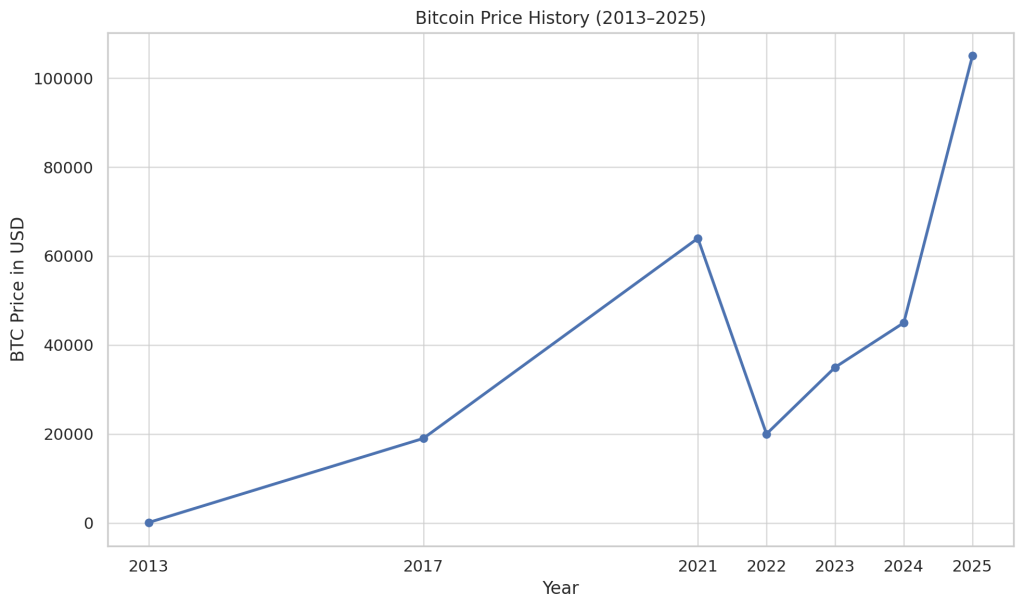
If someone had bought BTC at the peak of the 2017 bull run ($19,000), they’d still be sitting on more than 5× returns by mid-2025. Even someone who bought the 2021 top ($69,000) would now be in profit. Bitcoin’s long-term trend has been up, despite its violent short-term drops.
This matters because it shows that timing doesn’t have to be perfect—what matters is time in the market, not market timing.
Bitcoin Price History Chart (2013–2025), showing key growth milestones that support the narrative in your article about whether it’s too late to buy BTC in 2025.
What’s Driving the 2025 Rally?
Understanding whether you’re “too late” depends on whether Bitcoin is near the top—or still mid-cycle.
Here are the key 2025 drivers:
- ✅ Post-halving supply shock: The 2024 halving reduced new BTC issuance by 50%, tightening supply.
- ✅ Massive institutional adoption: Pension funds, sovereign wealth funds, and insurance companies are now allocating to Bitcoin.
- ✅ Bitcoin ETFs booming: Trillions of dollars are flowing into regulated Bitcoin ETFs, creating persistent demand.
- ✅ Global currency fears: Rising national debt, inflation concerns, and CBDC skepticism are pushing people toward Bitcoin as a hedge.
- ✅ Retail FOMO just beginning: Google Trends and exchange inflows suggest retail mania hasn’t fully returned yet.
These suggest we may still be in the middle phase of this bull market, not the final stretch.
Bitcoin’s Potential: Is $200,000 Unrealistic?
Let’s look at current predictions from top analysts:
- Ark Invest: $250,000–$500,000 by 2030
- Standard Chartered: $150,000–$200,000 by end of 2025
- Fidelity: Sees BTC as a “long-term monetary asset” comparable to gold
- Bloomberg: “Bitcoin could follow the same trajectory as post-dot-com Amazon stock”
While nothing is guaranteed, many of these projections are based on scarcity economics, increasing institutional demand, and global adoption. If these models are even half right, then Bitcoin still has significant upside from today’s prices.
What If the Market Crashes Tomorrow?
It’s a fair concern. Bitcoin is notoriously volatile. But here’s what most successful investors do: they prepare for volatility, not run from it.
Strategies for reducing risk:
- 🟢 Dollar-Cost Averaging (DCA): Buy small, regular amounts over time.
- 🟢 Diversification: BTC can be a part of a broader crypto or finance portfolio.
- 🟢 Hold with conviction: Treat BTC as a 4–10 year investment, not a quick trade.
Even if BTC drops to $80,000 temporarily, long-term conviction and proper allocation can help you ride out the dip.
How Much Is Too Much to Invest in Bitcoin?
Bitcoin has outperformed nearly every major asset class over the past decade. However, that doesn’t mean you should put your entire net worth into it.
A few general guidelines:
- 💰 1–5% of your portfolio is a common recommendation among conservative financial advisors. This keeps your downside limited if BTC crashes, while still giving exposure to upside.
- 💰 5–15% is a range used by many crypto-focused investors who believe in Bitcoin’s long-term value but want to stay diversified.
- ❌ 100% allocation is high risk unless you’re experienced, can tolerate volatility, and truly understand Bitcoin’s fundamentals.
Your personal investment should reflect your risk tolerance, goals, and financial situation—not just the hype.
Who Should Not Buy Bitcoin in 2025?
Despite its growth and mainstream attention, Bitcoin is not for everyone. You should not buy BTC right now if:
- ❌ You’re expecting guaranteed short-term profits
- ❌ You can’t handle the possibility of a 30–50% drawdown
- ❌ You’re investing with borrowed money or credit
- ❌ You haven’t researched how to securely store crypto
Bitcoin is a long-term game. If you’re investing based on TikTok hype or Reddit threads without understanding what you’re buying, you might panic sell during the next correction.
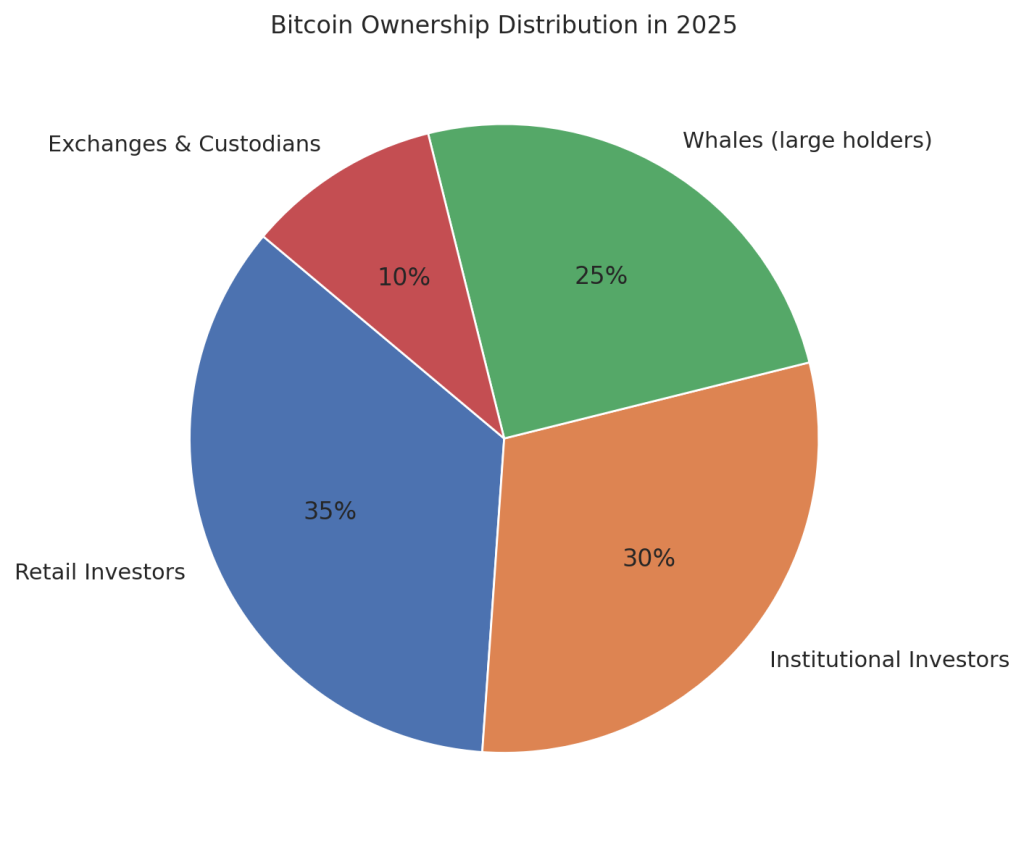
Bitcoin Ownership Distribution in 2025, showing how Bitcoin is divided among different groups—retail, institutions, whales, and custodians.
Bitcoin vs. Other Assets in 2025: Is It Still the Best Bet?
As of 2025, Bitcoin is still leading the crypto market. But is it better than stocks, gold, or even Ethereum?
Here’s a quick comparison:
| Asset | Risk Level | Potential Upside | Liquidity | Key Strength |
| Bitcoin | High | Very High | High | Scarce digital asset |
| Ethereum | High | High | High | Smart contract ecosystem |
| Gold | Low | Low–Moderate | High | Stable store of value |
| Stocks | Moderate | Moderate | High | Income and dividends |
Bitcoin continues to shine as a digital hedge and long-term asymmetric bet. But it’s smart to think of BTC as one part of a portfolio—not the entire plan.
Hybrid Strategies: Best of Both Worlds
Want to get exposure to Bitcoin but reduce your risk? Try one of these hybrid strategies:
- 🔄 BTC + Gold: Old and new stores of value side by side
- 💼 BTC + S&P 500 ETF: Blend growth and stability
- 💹 BTC + Stablecoins (e.g., USDC): Keep dry powder ready for dips
- 💻 BTC + ETH: Bet on both digital gold and the smart contract economy
These combinations allow you to benefit from crypto upside while staying diversified and flexible.
Final Verdict: Is It Too Late to Buy Bitcoin in 2025?
No—it’s not too late. But you have to approach it with the right mindset.
The best time to buy Bitcoin was probably years ago. The second-best time? When you understand what you’re investing in.
Bitcoin may be above $100,000, but its long-term story may not be fully written yet. If BTC follows a similar trajectory as early-stage tech companies or becomes a core global reserve asset, the price could still go much higher over the next decade.
Just be smart, stay informed, and treat it as a long-term investment—not a ticket to instant riches.
Common Mistakes to Avoid When Buying Bitcoin in 2025
If you’re new to crypto or coming back after a break, here are some classic mistakes that can cost you money—or peace of mind:
- Buying the top: Jumping in during hype phases without understanding market cycles.
- Using leverage: Trading with borrowed money multiplies risk. Even experienced traders get liquidated.
- Keeping funds on exchanges: Not your keys, not your coins. Use cold wallets for long-term storage.
- Falling for scams: Be wary of fake wallets, phishing emails, and too-good-to-be-true investment offers.
- Ignoring taxes: Crypto profits are taxable in most countries. Understand your local rules.
The more careful and educated you are, the more confidently you can navigate the ups and downs.
How to Buy Bitcoin Safely in 2025
Ready to buy BTC? Follow these steps:
- Choose a reputable exchange
Stick to well-known platforms like Coinbase, Kraken, Binance, or Bitstamp. - Set up 2FA and strong passwords
Secure your accounts against phishing or hacks. - Start with small amounts
Don’t rush. Buy in increments (“dollar-cost averaging”) to reduce timing risk. - Withdraw to a wallet you control
Use a hardware wallet (like Ledger or Trezor) for safe long-term storage. - Keep a backup of your seed phrase
Store it offline. If you lose it, your BTC is gone forever.
Bitcoin in 2030: Looking Beyond the Next Few Years
While this article focuses on 2025, smart investors ask: where could Bitcoin be in 2030?
- Will it be a globally accepted asset held by central banks?
- Will it compete directly with gold for institutional reserves?
- Or will it be regulated into irrelevance in some jurisdictions?
As of 2025, Bitcoin continues to gain ground in legitimacy, adoption, and infrastructure. While there are no guarantees, its upward trajectory remains one of the most compelling financial stories of the 21st century.
If you’re thinking long-term and can stomach the volatility, even at six figures per coin, it still might be early.
What About Other Cryptocurrencies? Why Bitcoin Still Leads
As Ethereum, Solana, and dozens of other blockchains continue to innovate with smart contracts, NFTs, and DeFi ecosystems, you might wonder — why keep focusing on Bitcoin in 2025?
The answer lies in Bitcoin’s unique position in the crypto space:
- Security and decentralization: Bitcoin remains the most secure and decentralized blockchain in existence. No single party controls it, and its network has never been compromised.
- Store of value thesis: While Ethereum excels at utility, Bitcoin is still regarded as “digital gold” — a store of value immune to inflationary policies.
- Institutional trust: Bitcoin is the first stop for banks, pension funds, and public companies venturing into crypto. Spot ETFs approved in major economies center almost exclusively around BTC.
- Brand and network effect: Bitcoin’s brand recognition is unparalleled. Newcomers may not understand the difference between ETH, SOL, or AVAX — but they’ve heard of Bitcoin.
While altcoins can provide greater short-term upside, they also carry greater downside risk and uncertainty around regulation and future relevance. Many savvy investors use BTC as the anchor of their crypto portfolio — the asset they trust long-term.
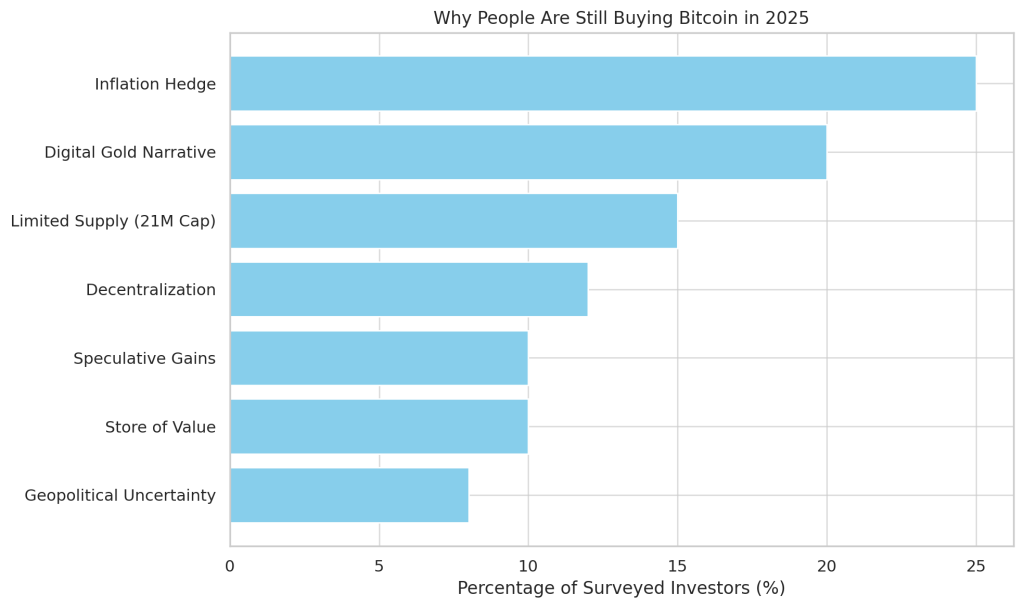
Why People Are Still Buying Bitcoin in 2025, showing key motivations such as inflation hedging, belief in digital gold, and store-of-value properties.
Bitcoin and the Rise of “Digital Nations”
An intriguing 2025 trend is the growing alignment between Bitcoin and the idea of “digital sovereignty.” In an increasingly chaotic world, where people are skeptical of central banks, borders, and traditional institutions, Bitcoin offers something radical: a financial system without rulers.
From:
- El Salvador adopting BTC as legal tender
- To remote workers and digital nomads using BTC to store and move wealth globally
- To citizens in inflation-wracked economies turning to Bitcoin out of necessity
…the digital asset is no longer just a speculative tool — it’s a lifeline for millions.
In this context, buying Bitcoin isn’t only about profit. For many, it’s about freedom — from currency debasement, political risk, and financial censorship. As macroeconomic instability continues across various regions, BTC’s narrative as a lifeboat could grow even stronger.
Will Bitcoin Ever Stabilize?
A common question from those considering Bitcoin today is: Will the wild volatility ever stop?
The answer is nuanced. Bitcoin has already become less volatile over time as liquidity deepens, institutional players arrive, and markets mature. But it’s unlikely to behave like a stable, boring asset any time soon.
What’s more likely is a long-term pattern of diminishing volatility — smaller crashes, slower rallies, and more “sideways” price movement. This evolution mirrors gold’s historical path: an asset that once saw wild swings before becoming the ultimate safe haven.
That said, we’re not quite there yet. As long as most BTC holders are still speculating rather than spending or holding for decades, the volatility will remain.
Still, for some investors, this high-risk/high-reward profile is exactly what makes Bitcoin attractive in the first place.