

The first half of 2025 has been anything but quiet for Bitcoin traders. As the digital currency matures, it no longer swings wildly just because of hype or social media buzz. Today, Bitcoin is increasingly tethered to macroeconomic forces: central bank policy, geopolitical shocks, and systemic liquidity shifts. This shift has created a new era of trading—one where strategy, timing, and macro awareness are more important than ever.
In this article, we’ll explore how to trade Bitcoin in 2025 with a focus on what’s driving the market, how to position around key events, and which trading strategies can outperform in this era of structured volatility.
Understanding What Drives Bitcoin in 2025
Bitcoin used to be a renegade asset. It moved independently of the traditional financial system and responded primarily to events within the crypto ecosystem. But that has changed. In 2025, Bitcoin’s price behavior is heavily influenced by institutional flows, central bank decisions, and cross-market sentiment.
There are three key drivers to understand this year:
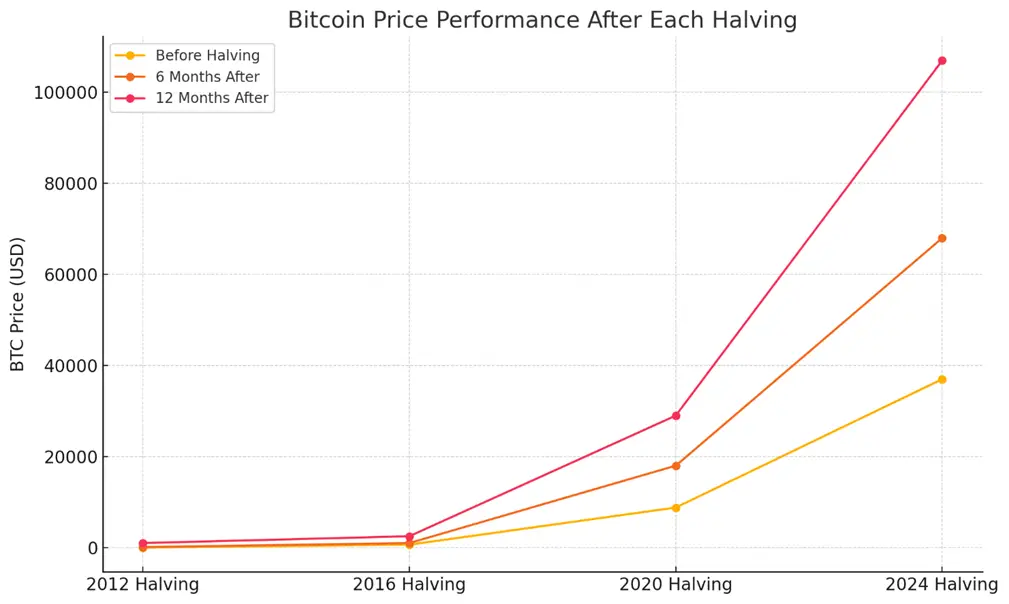
First, the post-halving environment. Bitcoin’s most recent halving occurred in April 2025, cutting the block reward from 6.25 to 3.125 BTC. Historically, halvings precede bull runs by several months, as supply reduction gradually meets long-term demand. We saw similar delayed rallies in 2013, 2017, and 2020. In 2025, the same pattern is playing out, but with a twist—demand is now also influenced by ETF inflows and the U.S. Treasury’s new Strategic Bitcoin Reserve, which adds institutional stability but also mutes speculative excess.
Second, monetary policy. The Federal Reserve, once an afterthought for crypto traders, is now central to Bitcoin’s behavior. In March and June of 2025, dovish language from the Fed pushed BTC higher. The market now treats Bitcoin much like a high-growth tech asset—reactive to interest rate expectations and macro liquidity trends. The upcoming September and December Fed meetings will be closely watched by BTC traders.
Third, geopolitical volatility. When Israel launched airstrikes on Iranian nuclear facilities in June, Bitcoin initially dipped as markets entered risk-off mode. Gold rose, the dollar strengthened, and equities pulled back. Yet within 48 hours, Bitcoin rebounded, aided by a narrative of “digital gold in wartime.” This episode revealed the asset’s evolving identity: Bitcoin is not yet a full safe haven, but it is learning to behave like one under specific conditions.
Bitcoin’s Price Action So Far in 2025
Let’s review how Bitcoin has performed in relation to key 2025 events:
| Event | Date | Price Reaction |
| Bitcoin Halving | April 19 | +8% over next 10 days |
| Fed hints at rate cuts | June 12 | +5% in 48 hours |
| Israel-Iran escalation | June 13–14 | -2% dip, then +4% rebound |
| Q2 earnings season (US stocks) | May | Choppy, range-bound behavior |
As of mid-June 2025, Bitcoin trades in a wide range between $101,000 and $115,000, with most institutions treating $105,000–$110,000 as a new structural support zone. Some algorithmic strategies even buy aggressively when BTC falls below $100,000, suggesting psychological and technical floors are converging.
Trading Strategy #1: Swing Trading Around Macro Events
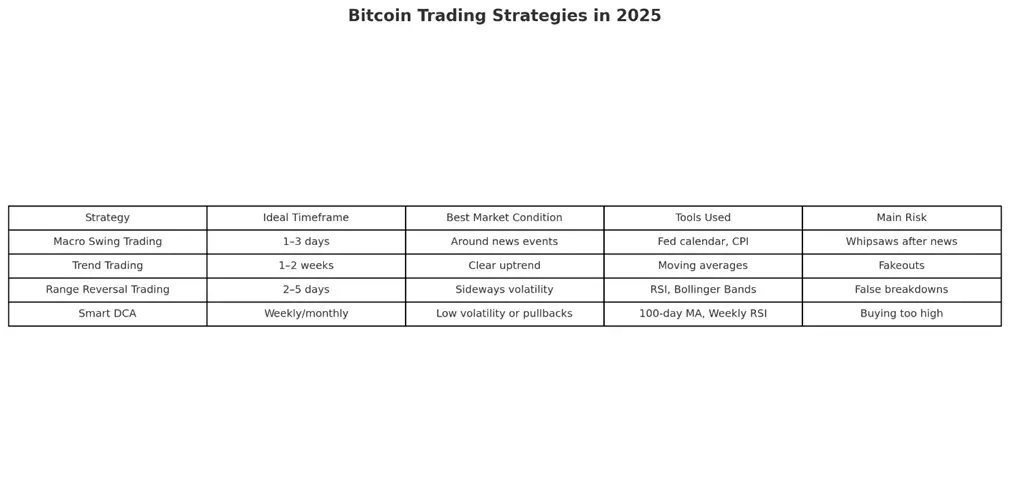
One of the most effective strategies in 2025 is macro-based swing trading. This involves entering trades 24–72 hours before or after major events such as Fed meetings, inflation reports, or large ETF flows.
For example, before the June FOMC meeting, Bitcoin had been drifting sideways for over a week. Traders who anticipated a dovish shift bought near $102,000 and exited near $110,000. That’s an 8% return in less than three days.
This strategy requires:
- Monitoring central bank calendars
- Understanding the difference between market expectations and actual policy shifts
- Managing risk with tight stop-losses and smaller positions ahead of volatile releases
Bitcoin no longer reacts solely to crypto-native news. It now trades more like a macro asset with leverage. Recognizing that shift is essential.
Trading Strategy #2: Trend Trading with Technical Anchors
Despite its macro sensitivity, Bitcoin’s price still responds well to classic technical tools. Moving averages, Bollinger Bands, and RSI levels remain useful, but with longer timeframes.
The 100-day and 200-day moving averages are particularly relevant in 2025. The 100-day MA has consistently supported Bitcoin in the $105,000 region, making it a buying zone for both short-term and position traders.
Meanwhile, trend-followers can use breakouts above resistance levels, particularly psychological ones like $115,000 or $120,000. These round numbers tend to attract retail participation, and when volume surges, follow-through can be swift.
Caution is still needed: fakeouts remain common. Always confirm breakouts with volume spikes and hold periods of at least four hours on high timeframes.
Bitcoin Price Forecast Ranges Through 2025
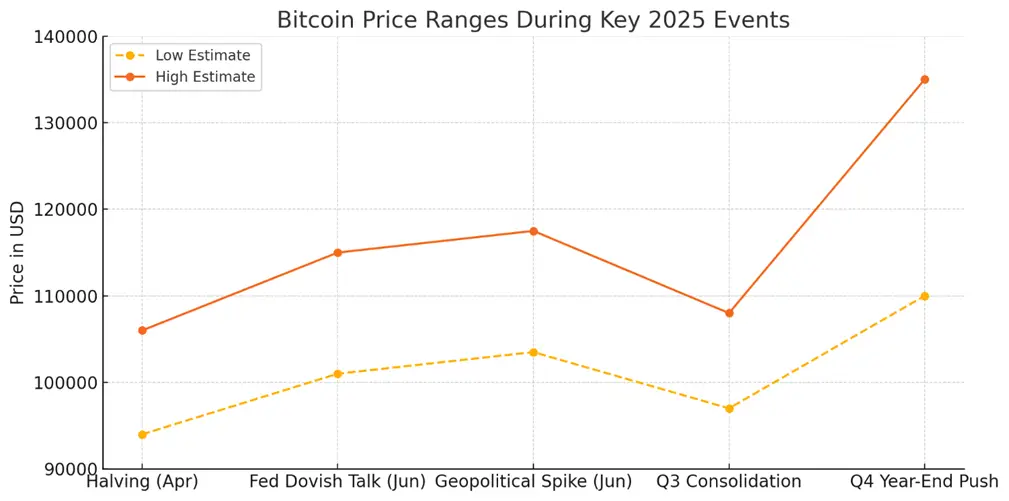
To give traders a reference, here’s how Bitcoin might trade through key phases of the year.
| Event Period | Low Estimate | High Estimate |
| Post-halving (Q2) | $94,000 | $106,000 |
| Fed dovish pivot (June) | $101,000 | $115,000 |
| Geopolitical volatility | $103,500 | $117,500 |
| Q3 consolidation | $97,000 | $108,000 |
| Q4 year-end rally | $110,000 | $135,000 |
The broader consensus suggests Bitcoin will likely stay within a $95K–$130K range for the remainder of the year, barring a major economic or geopolitical shock.
Trading Strategy #3: Range Trading with Reversal Patterns
With macro volatility high but directional confidence low, Bitcoin often spends weeks in wide ranges. In 2025, this has allowed skilled traders to exploit range-bound conditions.
The key is to identify:
- Overbought/oversold RSI on daily chart (above 75 or below 25)
- Fake breakouts at major levels ($100K, $110K)
- Bollinger Band compression followed by expansion
When Bitcoin trades between $100K and $110K, a reversal strategy—buying near support and selling near resistance—has delivered steady results, particularly when paired with lower leverage and a multi-day timeframe.
Avoid intraday scalping in these conditions unless you have access to order flow data or proprietary bots.
Trading Strategy #4: DCA with Intelligent Timing
For long-term investors, dollar-cost averaging remains valid—but it can be enhanced in 2025 by overlaying macro and technical context.
Instead of buying fixed amounts every week, adjust your buys during:
- Periods of low volatility
- After strong pullbacks or failed breakdowns
- When BTC trades near its 100-day MA or touches RSI oversold on the weekly chart
This “smart DCA” approach retains the discipline of averaging while adding the flexibility of value-based timing.
In 2025, blindly DCA’ing at $117K while ignoring signs of a 10% pullback could mean missing better opportunities. Patience now pays more than ever.
What Not to Do in 2025
Bitcoin’s increased institutionalization has changed the game—but bad habits still persist.
Avoid these common pitfalls:
- Over-leveraging on short timeframes. With increased ETF liquidity and algorithmic flows, price can spike against you in seconds.
- Chasing pumps. If BTC rallies 10% in 24 hours on news, it often retraces by 4–6% within two days.
- Ignoring macro. Earnings reports, CPI releases, and Fed policy statements now move BTC just as much as crypto-native news.
- Trading altcoins based on BTC’s strength. Many altcoins are still decoupled and may underperform even during BTC uptrends.
A disciplined, patient, and data-driven approach is more effective in 2025 than ever before.
Tools and Platforms to Use
Trading successfully in 2025 requires high-quality tools:
- TradingView Pro: for advanced charting, alerts, and script automation
- Binance, Kraken, or KuCoin: for liquidity and multi-asset exposure
- Coinglass and Hyblock Capital: for liquidation and sentiment data
- Economic calendars (like ForexFactory or Investing.com): to stay ahead of macro releases
If you’re running bots, ensure you throttle leverage and volume, as many scripts built in earlier cycles do not handle institutional liquidity surges well.
Final Thoughts
Bitcoin in 2025 is no longer a rogue asset. It’s a volatile but maturing instrument that trades in response to a wider range of inputs than ever before. From the Federal Reserve to the Middle East, from ETF inflows to global GDP projections—Bitcoin has grown up. Trading it successfully requires understanding that shift and adapting strategies accordingly.
Whether you’re a swing trader riding macro events, a technical analyst watching the 100-day MA, or a long-term accumulator tweaking your DCA plan—what matters is precision, patience, and perspective.
The easy money phase is over. But for disciplined traders who adapt to the structure and tempo of the 2025 market, the opportunities are still enormous.
The Psychology of Bitcoin Trading in 2025
Beyond technical setups and macro awareness, success in Bitcoin trading increasingly hinges on psychological control. In earlier cycles, FOMO (fear of missing out) and panic selling dominated retail sentiment. While those emotions still exist, today’s market includes hedge funds, algo traders, and structured ETFs—all of which operate on probabilistic logic rather than emotional swings. As a retail trader or even a semi-professional, understanding and managing your own emotional reactions is now a competitive advantage.
In 2025, the emotional landscape has shifted from raw greed to strategic doubt. Traders who watched Bitcoin double from $50,000 to $100,000 now ask: Is it too late? Meanwhile, those who sat on the sidelines hope for a correction to “get in.” This hesitation often leads to late entries, buying tops, and selling into short-term panic. Understanding that Bitcoin has become both less explosive and more structured means that timing is about preparation—not impulse.
One of the best tools to combat these psychological traps is journaling. Noting why you entered a trade, what you expected, and how you felt during drawdowns builds emotional self-awareness. It’s no longer enough to know where Bitcoin might go—you need to know how you’ll behave when it gets there.
Risk Management in a Structurally Volatile Market
In the past, traders would use wide stop-losses or no stop-losses at all, relying on hope and recovery bounces. In 2025, that is no longer viable. Institutional players often flush the market just enough to trigger stop cascades, and price can sweep through technical levels before reversing sharply. That’s not manipulation—it’s how large positions manage entry and liquidity.
To survive this structure, modern risk management must adapt. Instead of stop-losses based solely on percentage distance (e.g., -5%), consider using:
- ATR-based stops (Average True Range): set stops based on recent volatility
- Structure stops: place exits below swing lows or invalidation levels
- Position sizing: risk 0.5–1.5% per trade depending on setup confidence
Another overlooked element is time-based exits. If Bitcoin doesn’t move as expected within 24–72 hours, consider exiting. Stagnant trades often precede adverse moves.
The principle is simple: stay in the market long enough to benefit from its long-term logic. That means taking small losses early and letting winners grow.
Bitcoin as a Strategic Portfolio Position in 2025
Many investors think of Bitcoin as something to trade. But in 2025, it’s increasingly viable as a strategic allocation—an asset that complements traditional investments like gold, equities, or real estate.
Bitcoin’s correlation with the S&P 500 has decreased slightly in recent months, especially during geopolitical tension. It no longer behaves purely as a tech proxy. This opens the door for Bitcoin to serve as a:
- Long-term inflation hedge
- Digital reserve asset
- Volatility amplifier for balanced portfolios
In some institutional models, a 1–3% BTC allocation is used not to chase gains, but to improve risk-adjusted returns through diversification. Even small Bitcoin holdings can enhance the Sharpe ratio when balanced against less volatile assets.
For retail investors, this approach means you don’t need to “go all in” on Bitcoin. A 5–10% core holding, rebalanced quarterly, combined with a 1–2% active trading slice, allows you to benefit from both long-term appreciation and short-term price action.
Looking Ahead: What Could Change the Game
While 2025 has already delivered major catalysts—rate shifts, geopolitical tension, and the halving—the second half of the year holds additional unknowns.
Key developments to watch include:
- ETF inflows acceleration: If spot ETFs continue to absorb supply, BTC could break out of its range sharply.
- A surprise Fed hike or recession: A hard landing could depress all risk assets, including Bitcoin.
- Regulatory shocks: If the U.S. or EU introduces sudden clampdowns on self-custody or taxes, sentiment could shift overnight.
And of course, global conflict escalation remains a wildcard. While gold benefits most directly from war, Bitcoin could begin behaving more like a digital hedge if traditional banking systems are disrupted.
As always, scenario planning beats prediction. Traders and investors who prepare for multiple outcomes tend to outperform those locked into a single thesis.
Summary: Evolving with the Market
Bitcoin trading in 2025 is no longer about guessing the next breakout meme coin or catching 100% moves in a weekend. It’s about disciplined execution, smart risk management, and staying informed on macro catalysts. The volatility remains—but the logic behind the moves has matured.
Whether you’re trading short-term swings, allocating for long-term value, or doing both, the new Bitcoin market rewards those who act like professionals, not speculators. It’s less about speed—and more about structure, insight, and adaptability.
And for those who master that new rhythm, Bitcoin in 2025 still offers something rare in global finance: asymmetric upside.